Chanel
Reimagining Chanel’s queue as a branded service experience
At Chanel’s 31 Cambon boutique in Paris, the queue is more than an operational challenge, it is a critical moment in the client journey. This work explored how waiting could become a branded service experience, supporting boutique operations while making clients feel welcomed, considered and closer to the maison before they stepped inside.
From queue management to brand experience
The brief started with an operational pain point: how could Chanel better support clients waiting outside the 31 Cambon boutique?
We reframed the queue as an antechamber to the boutique experience: a moment where clients could be acknowledged before entering, staff could better understand their intent and digital touchpoints could prepare the visit without replacing the human service.
Making the wait feel considered
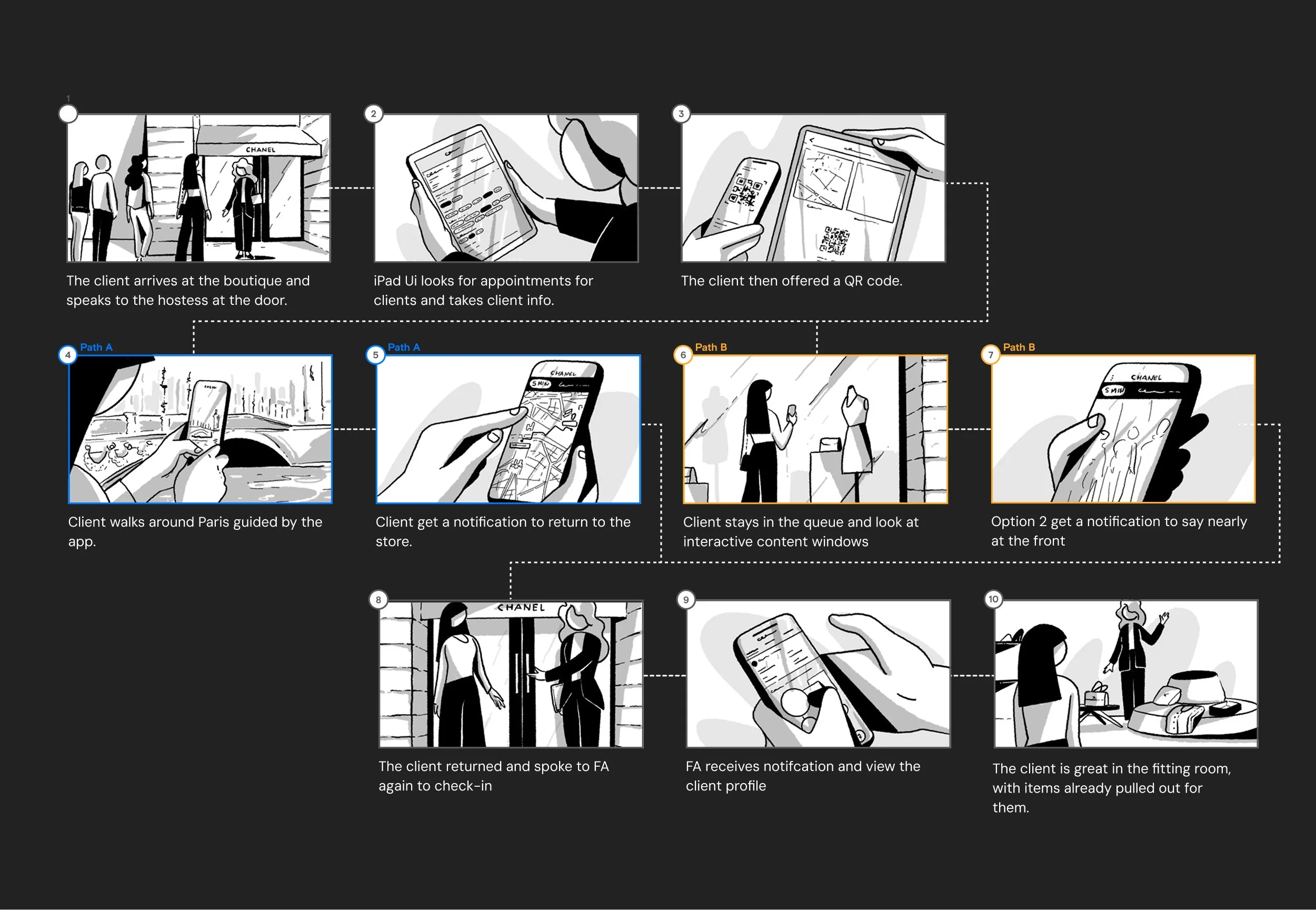
The experience needed to support two different behaviours. Some clients would choose to stay nearby and queue physically. Others could queue virtually and explore the neighbourhood while waiting for their appointment.
In both cases, the goal was to make the waiting time feel considered rather than passive: helping clients feel oriented, offering relevant brand content and giving the Fashion Advisors better context and time to prepare before the experience in-store began.
My design contribution
Turning an early service concept into 4 testable prototypes across Line Host, client-facing, and Fashion Advisor touchpoints.
Defining the physical and virtual queueing journeys, including how clients would be triaged, guided and prepared before entering the boutique.
Creating polished UI from rough wireframes, translating Chanel’s brand world into digital touchpoints without making the experience feel transactional.
Designing the handoff between boutique roles, so client context could move from Line Host to Fashion Advisor with minimal repetition.
Structuring and collecting content for the waiting experience, from neighbourhood storytelling to collection immersion.
Using stakeholder reviews to refine quickly, aligning UX, UI, content and service details within a four-week sprint.
Designing four signature moments
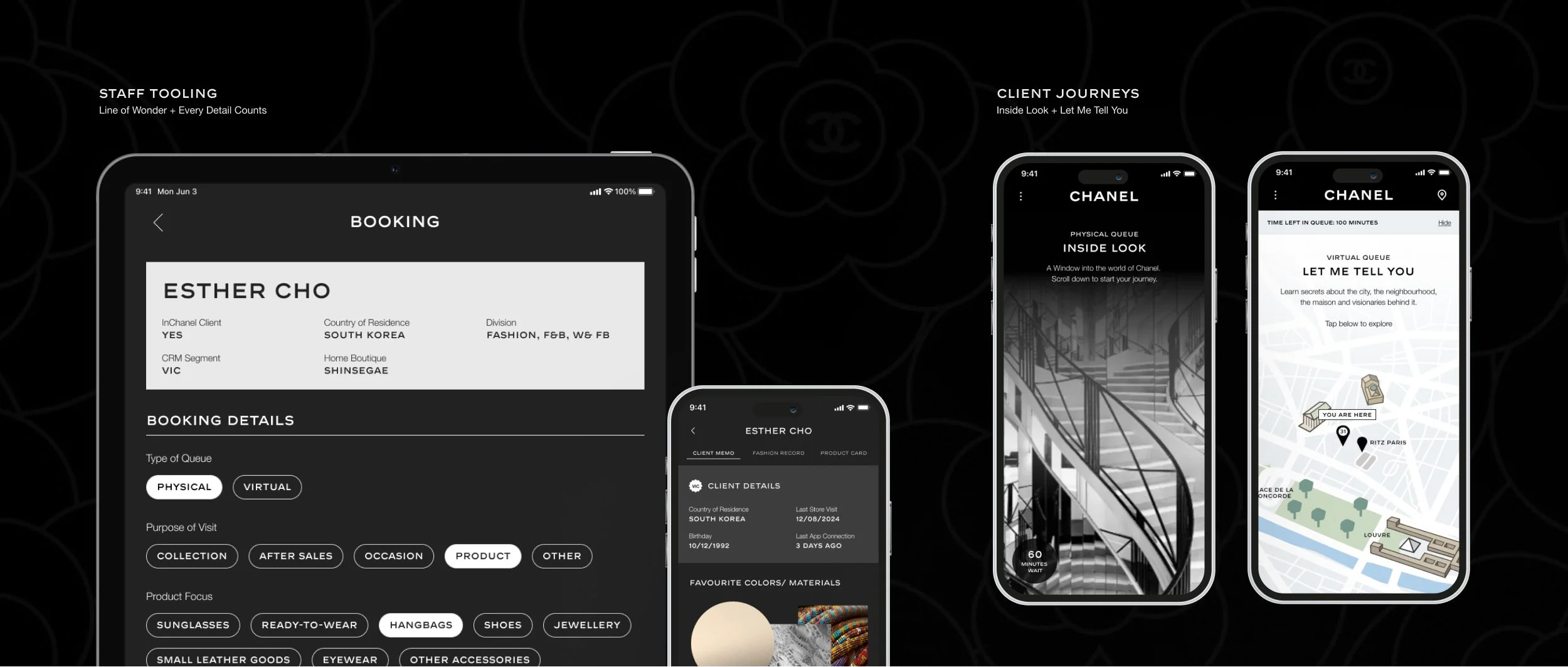
The outcome was a set of four cross-device concepts designed to support the boutique waiting experience from arrival to appointment.
Line of Wonder helped the Line Host triage clients, manage physical and virtual queueing and capture relevant information ahead of the appointment. This gave staff a clearer way to understand each client’s intention: wait in line, queue virtually or book a future visit.
Let Me Tell You supported virtual queueing by inviting clients to explore the surrounding neighbourhood and its relationship to the Maison. The experience offered editorial content during the wait, creating a sense of privileged access while deepening the connection between place, brand, and boutique visit.
Inside Look supported physical queueing through a collection immersion experience. Clients could explore product content before entering the boutique, helping them arrive with more context and making the wait feel connected to the shopping journey.
Every Detail Counts helped the Fashion Advisor manage appointments, communicate availability, and receive client information with minimal repetition. This created a smoother handoff from Line Host to Fashion Advisor and made better use of the appointment once the client entered the boutique.
Designing for anticipation, not distraction
The client facing experiences were not designed to distract people from waiting. They were designed to make the wait feel like the first layer of the boutique journey.
Each touchpoint had a specific purpose: the Line Host tool created structure at arrival, the client pathways gave people something relevant to do while waiting and the Fashion Advisor tool helped prepare for a more personal appointment. Together, they connected the emotional expectations of luxury retail with the operational needs of the boutique.
Making the opportunity tangible
The prototypes were tested in Chanel’s Retail Lab with Boutique Directors, Fashion Advisors and internal stakeholders to understand whether the concepts added value to the queueing journey and were worth further investment.
Feedback was very positive and the work was taken internally for continued development. The concepts gave Chanel something concrete to react to, test, and build on — turning an ambiguous service opportunity into a clearer conversation about client care, boutique operations and the role of digital in luxury retail.
A lesson in restraint
This project sharpened my understanding of restraint in luxury UX: knowing when digital should lead and when it should quietly support the service around it.
Working within a four-week sprint, with high expectations and limited device access for iPad testing, pushed me to make decisions quickly, prototype with precision, and keep the experience tangible enough for stakeholders to evaluate. The value of the work was not in adding more digital touchpoints, but in making each one valuable.
Looking back with today’s AI tools
AI tools would allow me to move faster towards alignment by synthesising stakeholder feedback, exploring more interaction directions, drafting content routes and, mainly, accelerating early prototypes with tools like Figma Make.