Volvo Cars
Turning Service Plans into a scalable digital offer
Service Plans were already a proven digital offer in the Volvo Cars app but bringing it to .com meant solving a different challenge: making a complex after sales product understandable, comparable and effortless to purchase in an e-commerce context.
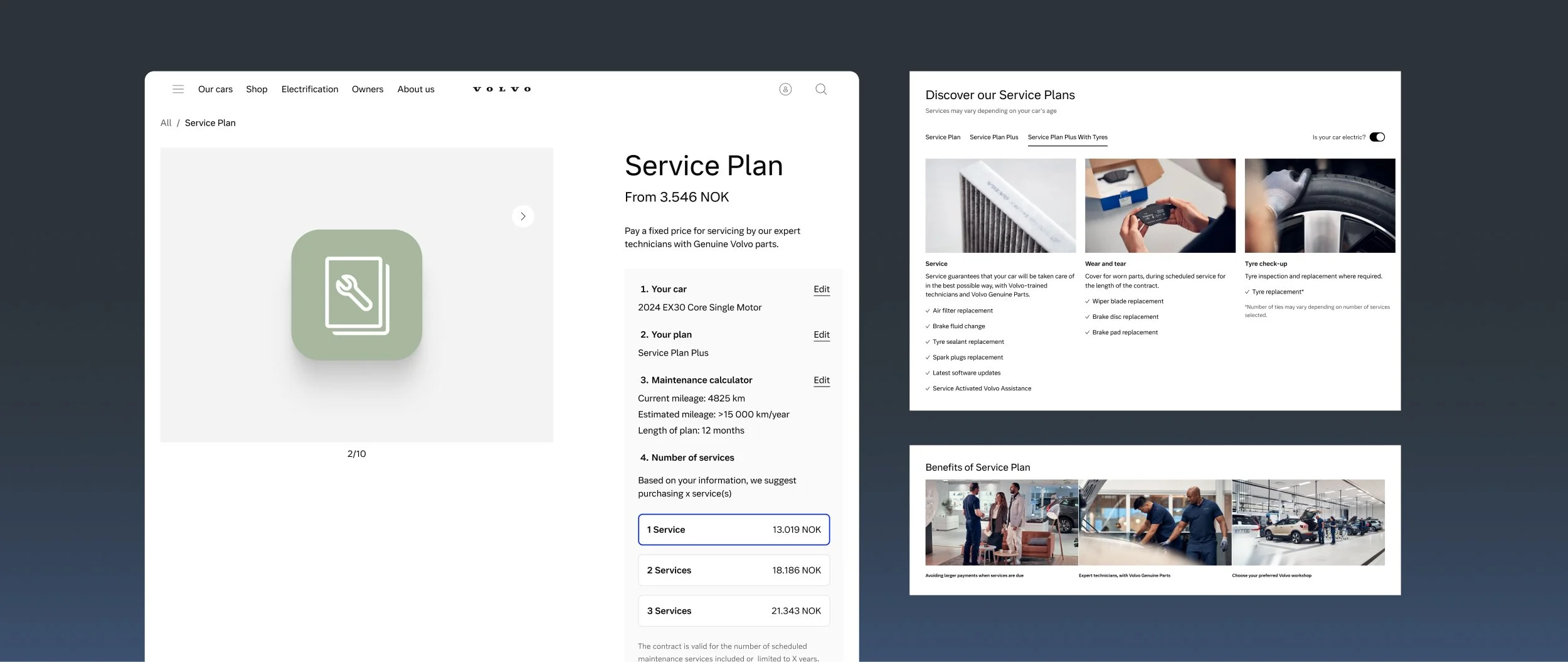
From ownership service to digital product
Service Plans is a product where costumers prepay for scheduled maintenance, creating more predictability around ownership costs and extending Volvo’s relationship with customers beyond the initial car purchase.
By extending the offer to our web users we have created an opportunity to reach customers in a broader shopping context and test a more scalable digital sales model. Norway became the pilot market, supporting EX30 customers. The app was already the mature channel; the web launch was about validating whether Service Plans could also work as part of Volvo’s broader e-commerce ecosystem.
Making a complex offer feel easier to choose
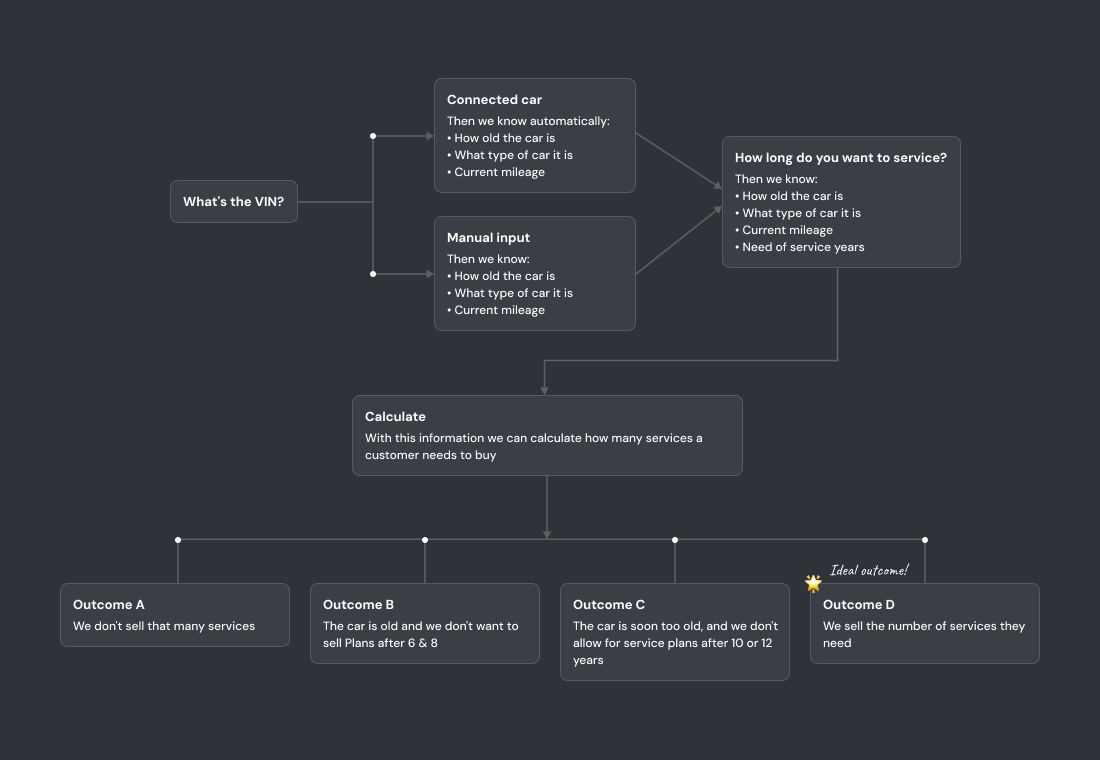
The challenge was not simply to put Service Plans online. It was to help customers understand an offer shaped by eligibility rules, service tiers, payment constraints, mileage, ownership duration and market-specific requirements without making the experience feel technical.
My design contribution:
Designing the web journey from VIN-based eligibility to car confirmation, plan comparison, guided selection,and purchase entry point.
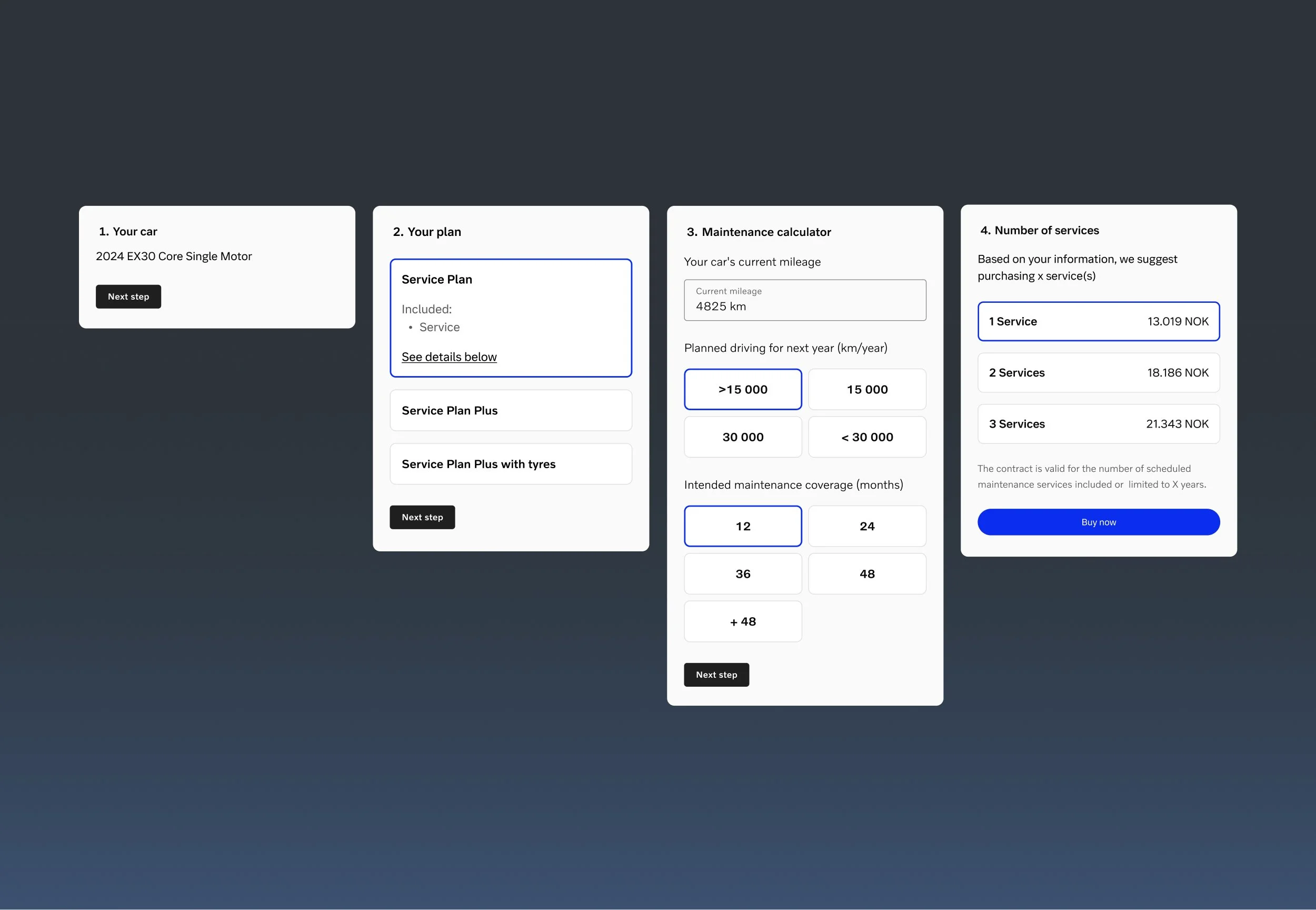
Introducing a multi-step wizzard that gathered customer inputs and translated them into relevant plan recommendations.
Simplifying complex offer logic around plan tiers, included services, number of services, and payment options into clearer customer decisions.
Using unmoderated user testing to identify where customers felt confident, where they hesitated, and what needed to be clarified before launch.
Partnering with content design to shape copy that balanced commercial requirements with customer understanding.
Creating prototypes for stakeholder reviews to pressure-test the journey, discuss trade-offs, and align on expectations before implementation.
Aligning product, legal, technical, marketing, and commercial requirements so the experience balanced customer clarity, compliance, feasibility, launch needs, and future scalability.
Designing for confidence
The experience was designed around the decisions customers needed to make not the internal complexity behind the offer.
VIN-based eligibility helped customers see relevant options for their car. The comparison experience made plan tiers easier to evaluate. A helper flow supported customers who were unsure how many services they needed, using inputs like mileage and ownership duration to guide them toward a suitable option.
The goal was not to remove choice but to make the choice feel clearer and more supported.
Learning where the confusion really was
Unmoderated testing showed that customers understood the purpose of the page and responded positively to the comparison tool. They valued being able to compare tiers and appreciated guidance when choosing between plans.
The main friction was language. Several users struggled with the meaning of “number of services” and needed a clearer explanation of how service count related to time, mileage and plan value. These insights helped simplify the interaction model, sharpen the copy and make the journey feel less like configuration and more like an informed ownership decision.
What the launch helped prove
The .com launch gave Volvo an early proof point that Service Plans could work beyond the app. From May 2025 to August 2026, customers purchased 142 BEV Service Plans through web, representing 4.1% of total digital Service Plan sales at the time of measurement.
The app remained the mature, high-volume touchpoint, but web validated a different opportunity: customers could discover, understand, and buy Service Plans directly through Volvo’s e-commerce journey. For the business and platform, this helped prove that aftersales products could scale beyond retailer-led sales and become part of Volvo’s broader digital commerce ecosystem.
Complex products do not always need more explanation, they need better decision structure.
The UX work was about knowing where customers needed reassurance, where the system needed to carry complexity in the background, and where design could help teams align around a scalable customer experience.
Looking back with today’s AI tools
If AI tools had been available in the way they are today, it could have helped me move faster from ambiguity to alignment. I would have used them to synthesize user testing, explore more design directions before committing to a final direction and map edge cases more quickly.